
Is Scoliosis a Disability That May Qualify for Social Security Disability Benefits?
Scoliosis may qualify as a disability for Social Security Disability Insurance (SSDI) and Supplemental Security Income (SSI) benefits, but approval depends on how severely the condition limits your ability to work—not on the diagnosis alone.
Many people with scoliosis work without significant limitations. Others develop spinal curvatures severe enough to cause chronic pain, nerve compression, and mobility restrictions that make sustained employment impossible.
What Is Scoliosis?
Scoliosis is an abnormal lateral curvature of the spine. In a person with scoliosis, their spine curves sideways—sometimes in a single arc or sometimes in an S-shape—which places uneven pressure on vertebrae, discs, and surrounding nerves.
Scoliosis is generally classified into four types:
- Idiopathic scoliosis is the most common type, with no clearly identified cause. It most often develops in adolescents during growth spurts.
- Degenerative scoliosis develops in adults, typically after age 40, as spinal discs and facet joints wear down over time.
- Congenital scoliosis is present at birth, resulting from abnormal vertebral development in the womb.
- Neuromuscular scoliosis is secondary to conditions affecting muscle and nerve function, such as cerebral palsy or muscular dystrophy. This type often progresses more rapidly than other forms.
The degree of spinal curvature is measured in Cobb angles on X-ray. Curves under 20 degrees are generally considered mild. Curves between 40 and 50 degrees are more likely to progress over time and may begin to affect breathing or cardiac function. Curves exceeding 50 degrees carry an increased risk of long-term complications.
Symptoms of Scoliosis That May Support a Social Security Disability Claim
 Not all scoliosis symptoms carry equal weight in a disability evaluation. The SSA is primarily interested in symptoms that prevent you from performing sustained work activity.
Symptoms that are most relevant to a disability claim include:
- Radicular pain: Pain that radiates from the spine into the arms or legs, following a nerve pathway. This is a key symptom under Blue Book Section 1.15 and indicates nerve root involvement.
- Paresthesia: Numbness, tingling, or abnormal sensation in the extremities caused by nerve compression.
- Muscle weakness: Weakness in the legs (for lumbar curves) or arms (for cervical curves) that limits your ability to lift, carry, or sustain work activity.
- Reduced standing and sitting tolerance: An inability to remain in one position long enough to complete a normal workday. This is one of the most significant functional limitations the SSA considers.
- Limited range of motion: Difficulty bending, stooping, twisting, or reaching, which affects the range of jobs you can physically perform.
- Breathing difficulties: In severe thoracic scoliosis, the spinal curvature can compress the rib cage and reduce lung capacity. When breathing is affected, the SSA may also evaluate the condition under its Respiratory Disorders listings.
Your medical records should document these symptoms consistently over time. A single exam note describing back pain carries less weight than a longitudinal record showing the same functional limitations visit after visit.
Scoliosis Treatment Options and Why They Matter for Your SSDI Claim
The SSA evaluates your treatment history as part of assessing the severity and expected duration of your scoliosis. Common treatment approaches include observation and monitoring for mild curves, physical therapy to improve strength and flexibility, bracing for adolescents to slow curve progression, pain management through medication or injections, and spinal fusion surgery for severe or progressing curves.
From a disability standpoint, what matters is whether your symptoms have continued despite treatment. If you have completed physical therapy, tried pain management, and still cannot sit or stand for a normal workday, that treatment history strengthens your claim.
How the SSA Evaluates Scoliosis for Social Security Disability Benefits
Scoliosis does not have its own dedicated listing in the SSA Blue Book. The SSA explicitly states that spinal curvatures affecting musculoskeletal functioning are evaluated under Section 1.15. If your scoliosis causes breathing problems, the SSA may also evaluate it under Section 3.00 (Respiratory Disorders). If it impairs cardiac function, it may fall under Section 4.00 (Cardiovascular).
Blue Book Section 1.15: The Four-Part Test
To meet Listing 1.15, your medical records must document all four of the following criteria simultaneously, or within a four-month period:
A. Radicular symptoms: Radicular distribution of pain, paresthesia (abnormal sensation such as tingling or numbness), or muscle fatigue consistent with nerve root compromise.
B. Objective neurological signs: A physical examination must document muscle weakness and signs of nerve root irritation or compression, combined with either sensory changes (decreased sensation or abnormal nerve conduction on electrodiagnostic testing) or decreased deep tendon reflexes.
C. Imaging findings: An X-ray, MRI, or CT scan must show evidence of nerve root compromise in the cervical or lumbosacral spine. Those imaging findings must have lasted, or be expected to last, at least 12 months.
D. Functional limitation with documented assistive device use: This criterion was added in the 2021 revision and significantly raised the bar compared to the old Section 1.04. The SSA requires medical documentation of at least one of the following, lasting or expected to last at least 12 months:
- A documented medical need for a walker, bilateral canes, bilateral crutches, or a wheeled and seated mobility device requiring the use of both hands
- An inability to use one upper extremity for work-related activities involving fine and gross movements, and a documented medical need for a one-handed assistive device that requires the use of the other upper extremity
- An inability to use both upper extremities to the extent that neither can be used for work-related activities involving fine and gross movements
The Residual Functional Capacity Pathway—How Most Scoliosis SSDI Claims Are Won
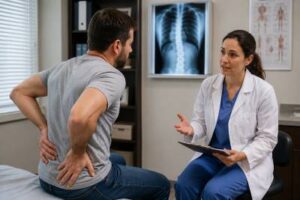 When a condition does not meet a specific Blue Book listing, the SSA assesses what you can still do through a Residual Functional Capacity (RFC) evaluation. The RFC determines whether any work exists in the national economy that you are physically capable of performing on a sustained, full-time basis.
For scoliosis, the RFC typically focuses on limitations in:
- Sitting and standing tolerance: How long you can sit or stand before needing to change position or lie down
- Walking capacity: How far and how long you can walk without stopping
- Lifting and carrying: The maximum weight you can safely lift and how frequently
- Postural limitations: Whether you can bend, stoop, crouch, or climb
- Reaching and handling: Whether nerve compression affects arm or hand function
The SSA uses RFC results along with your age, education, and work history to determine whether you can perform your past work or transition to other work. For claimants over 50, the Medical-Vocational Guidelines, commonly called the Grid Rules, give significant weight to age when evaluating whether a person can realistically adapt to less physically demanding work.
What Medical Evidence Strengthens a Scoliosis SSDI Claim
A scoliosis Social Security Disability claim succeeds or fails on the strength of its medical documentation. Imaging alone is not sufficient. The SSA requires evidence of how scoliosis affects your functioning.
Your records should include:
- Current imaging studies: MRI results are typically more useful than X-rays alone for establishing nerve root compression, as they show soft tissue and disc involvement. Imaging from several years ago may not reflect your current condition.
- Physical examination records: Consistent documentation from your treating physician of specific functional limitations, such as range of motion, reflexes, sensory testing, and muscle strength testing, can help your claim.
- Treatment history: Records of all treatments received, including physical therapy, pain management, injections, and surgery, should be included. Gaps in treatment can significantly weaken a claim.
- RFC forms: An RFC form completed by your treating physician documenting your specific work-related limitations, such as how long you can sit, stand, and walk, and how much you can lift, carries significant weight with SSA decision-makers.
How Hard Is It To Get Social Security Disability for Scoliosis?
Scoliosis claims are among the more difficult musculoskeletal cases to win at the initial application stage because the condition varies widely in severity, and because the SSA’s current Blue Book listing sets a high bar that many claimants do not meet on paper.
Many cases that are denied at the initial application stage are later approved at the Administrative Law Judge (ALJ) hearing level, where a more complete medical record can be presented. The initial decision is not the final one.
The strongest scoliosis claims share common characteristics: consistent treatment with a specialist over time, objective imaging showing structural abnormality, physician documentation of specific functional limitations, and clear evidence that those limitations have persisted, or are expected to persist, for at least 12 consecutive months.
SSDI vs. SSI for Scoliosis
Understanding the difference between SSI and SSDI is important before applying. The SSA administers two separate disability programs with identical medical eligibility criteria but different financial requirements.
Social Security Disability Insurance (SSDI) is available to individuals who have worked and paid Social Security taxes for a sufficient period. For most workers, this means having worked at least five of the last 10 years before becoming disabled.
Supplemental Security Income (SSI) is a needs-based program for individuals with limited income and assets, regardless of work history. The maximum federal SSI benefit in 2026 is $994 per month for individuals. SSI recipients are generally eligible for Medicaid immediately upon approval.
In many cases, you may qualify for both programs, and the SSA will determine which applies based on your work history and finances.
How a Social Security Disability Lawyer Can Help
Applying for Social Security Disability benefits requires gathering the right medical documentation and presenting your functional limitations in a way that maps clearly to SSA standards. Many initial applications are denied not because the claimant doesn’t qualify, but because the medical record doesn’t adequately document why they can’t work. A Social Security Disability attorney can identify those gaps before the SSA sees them and build a stronger record before you file.
If your SSDI application is denied, representation at the Administrative Law Judge hearing stage significantly improves your chances of approval. Bender & Bender has helped Social Security Disability claimants across the country for over 60 years. Contact our office or call 212-605-0343 to discuss your case.